
Then the Lord asked Satan, “Have you noticed my servant Job? He is the finest man in all the earth. He is blameless—a man of complete integrity. He fears God and stays away from evil.” Job 1:8
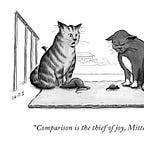
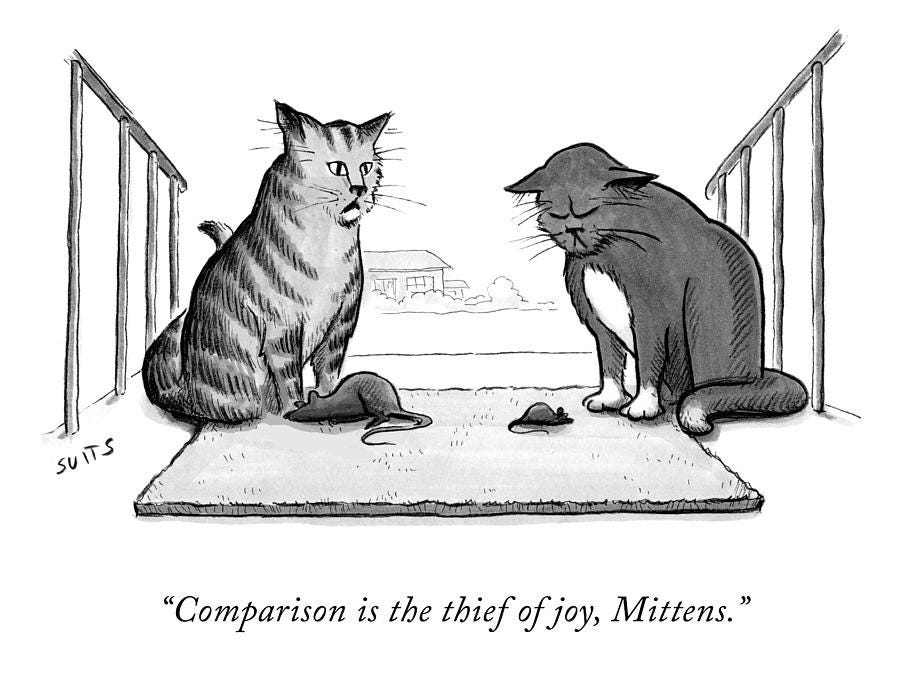
If you scroll around social media long enough, you are bound to encounter quippy aphorisms that offer life advice. One that appears quite often says, “Comparison is the thief of joy,” which seems especially appropriate as we peruse the highlight reels of other people’s lives that often appear to be full of more friends, fun, and fashion than ours. Yet, it appears to me that almost all our knowledge of who we are and what we want to be is based in comparisons.
Please allow me a moment in Blog #5 to veer from explaining my research process. When I was reviewing my first study notes as I prepared to write Blog #4, in which I intended to explain my research process, I noticed something that sent my mind flying in a new direction (the very phenomenon I was just describing in Blog #4). As is often the case, I noticed this sidebar topic popping up in other places, as well, so I took that as a sign from the Lord that I needed to pause here for a minute and think.
I want to take a moment to look at those very first notes I took when I began my study of the Book of Job on September 5, 2023. These were notes from reading the introductory material in my Bible that gave me some background info and an overview of what the Book of Job was all about.
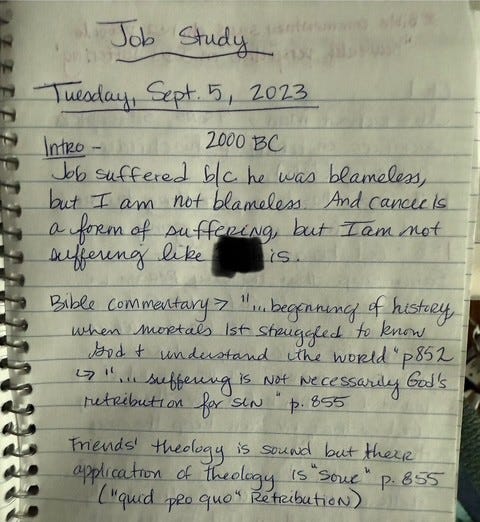
You can see in this photo from my first notes that I began my study by comparing myself to Job. Then, I compared my suffering to someone who happened to be going through a truly traumatic experience. I blacked out their name because I haven’t asked them permission to share their story, but when I began studying Job, I knew that my suffering couldn’t compare to the horrors some others have endured, and I also knew that I was not blameless like Job.
I said I did not intend for this study to be a comparison among suffering, and yet at the very beginning of my study, my first words were a comparison of suffering. It seems inevitable; we find ourselves comparing our struggles to the struggles of others for multiple reasons. Sometimes, we think, “Why are they complaining? They oughtta have to go through what I am going through.” Other times we think, “Why am I complaining? They are going through something far worse than I am, and I ought to be grateful that I have not experienced that.”
But wait. It is not just me comparing. The Book of Job itself appears to begin with such a comparison initiated by God, not the Accuser. Chapter 1, verse 8 says, “Then the Lord asked Satan, ‘Have you noticed my servant Job? He is the finest man in all the earth. He is blameless—a man of complete integrity. He fears God and stays away from evil.’”
The Accuser had said earlier that he had been patrolling the earth and watching everything that was going on, but the comparison starts with God’s comment that Job was “the finest man in all the earth.”
Whoa. This observation unleashed an avalanche of questions for me. Certainly, judgment from God is not based in comparison. Aren’t we judged as individuals based on our individual paths of life and our individual relationship with our Creator?
Or are judgment and comparison two different concepts altogether? Certainly, our lives are judged according to a firm standard such as the Bible or Jesus, correct? 1 Samuel 16:7 says, “The Lord doesn’t see things the way you see them. People judge by outward appearance, but the Lord looks at the heart,” and that would indicate a rejection of comparison, correct?
Is the Book of Job predicated on the idea that God protects some people more than others?
Could it be that God is challenging the Accuser by presenting him with this comparison? Because the Accuser comes right back with another comparison in Chapter 1, saying, of course, Job is righteous because you protect him (verses 9-11). Inherent in this response is another comparison - Job is protected whereas other humans are not. Is the Book of Job predicated on the idea that God protects some people more than others? It sure seems to be true in real life when we watch seemingly rotten people succeed without apparent suffering or punishment or retribution from God or society. Job, described as blameless by God himself, seems to take on the punishment that evil men are spared. But again, I only know this through comparison.
This makes me think Job’s story may be a lesson about the folly of comparisons, an examination of how useless it is to begin any conversation or endeavor by comparing one person or group to another, and the snowball effect that ensues once we start comparing.
Or maybe it’s a lesson about how the truly faithful remain faithful through all circumstances, even when someone else’s life looks a lot better than ours, but also a lesson about how the truly grateful react with humility and generosity when they are allowed a glimpse into someone else’s suffering.
We see this comparison occurring throughout the Book of Job. As soon as he opens his mouth after his silent mourning period, Job compares his life to the lives of those who died as babies, stating that he longed to be like them because his current misery is far worse than dying as a newborn (Chapter 3).
Job’s friends respond to Job’s self-pity with more comparisons. In chapter 4, verse 3, Eliphaz says, “My experience shows that those who plant trouble and cultivate evil will harvest the same.” He evaluates Job’s circumstances by comparing them to other lives he has known. They all seem to look for answers about why suffering exists by comparing who suffers and why they suffer. Their understanding is limited to their own experiences and the ways they have applied scripture to those experiences.
Their understanding is limited to their own experiences and the ways they have applied scripture to those experiences.
This is just one more reason the Book of Job cuts us so deeply and why many choose the simplified Mission Friends version of it. Could it be that comparison is an essential way we make meaning in our lives, such as comparing school subjects to see what profession we are interested in, or comparing fictional characters to our personal lives so that we might understand why people act the way they do?
If we sit and think about how often we claim to know something but then define it or describe it solely by comparing what it is similar to and what it is not, then we begin to see how often our steps are determined by comparisons. As teachers study pedagogy, we learn that one of the best ways for new learning to stick is by attaching the new learning to something we already know, creating a chain of knowledge where we embrace new understanding as it connects or extends what we already know. One might say, therefore, that the act of learning builds on comparisons through inductive reasoning. Here are a few oversimplified examples: we understand whether a creature qualifies as a mammal or a reptile based on comparisons between how they breed and how they stay warm. We understand the ways economic systems work by comparing the ways goods and services are distributed in the different systems. We understand Romanticism as a reaction against Rationalism, and we understand a station wagon has more storage room than a hatchback.
So many times our descriptive abilities are limited to, “It tastes like chicken.”
The more I thought about how pervasively comparisons fill our thoughts and form a foundation for the way we understand what it means to live, I felt swept away by one of those intellectual storms I described in Blog #4. I am going to have to continue this discussion of comparisons in Blog #6 because Blog #5 has grown too large, but for right now, let me leave you with my next observation about life:
Observation #5 - Original thought is elusive; we really just don’t know what we don’t know.


