

Why wasn’t I buried like a stillborn child, like a baby who never lives to see the light?
For in death the wicked cause no trouble, and the weary are at rest.
Even captives are at ease in death, with no guards to curse them.
Rich and poor are both there, and the slave is free from his master.
Job 3: 16 - 19
I noted in Blog #5 that comparisons often spiral. God mentioned Job in comparison to other humans, and the Accuser jumped back with another comparison (chapter 1). The insight here might be that if I start my thinking with comparisons, as I did when I made my first notes on the Book of Job, then my thoughts will tend to spiral into more comparisons. We compare new information to information we have already stored in our lives, decide its worthy interpretation, and internalize that decision. We know an experience to be good because we have experienced bad moments; we know a decision to be a smart one because we have previously made dumb ones.
But could comparison also be a catalyst for empathy and compassion? Or does it have the opposite effect and foster selfishness instead?
If we only know life as it happens to us, we have quite a limited view. Our positions in life certainly color our understanding of it. If I consider my positionality, as all competent researchers do, I know that my understanding of the way the world works has been shaped by my experiences. A white Gen X girl born into a southern, working-class family with generations of trauma; a first-gen college student; a girl raised in conservative, evangelical, patriarchal Christianity; a girl raised by a mother who loved her desperately but battled mental health demons and personal trauma; a girl shaped by strict expectations for what girls were allowed to be and do; a girl who played softball, took baton lessons and piano lessons, and played clarinet in the high school band; a Girl Scout and a hiker, someone who was taught that outside was better than inside and that stories were an inherent element of outdoor adventures.
My upbringing was rich in experiences but also quite limited. So much I simply didn’t know about life until I went away to college, married young and lived on a military base, got divorced, taught in a public school, and became a mom. My knowledge grew when I learned to see my epistemology as open to expansion. It grows even now as I take in new knowledge as a cancer patient.
Yet, this is not newsworthy material; we know that we instinctually try to make sense of our lives through comparisons. For example, back in Blog #3, I talked about how my mom did not want my childhood to resemble hers, so she made choices about how she would raise me based on comparison to her childhood. I did the same with my sons.
The lure of comparisons seems especially strong when we consider suffering.
I have been reading a book of theory from bell hooks entitled Feminist Theory from Margin to Center, and I discovered that she deals with the same issue. She disagrees with a comment from Leah Fritz, the author of Dreamers and Dealers, who wrote in 1979 that “suffering cannot be measured and compared quantitatively” (hooks, 2015, p. 4). When I first read Fritz’s comment, I nodded and agreed. Seems logical, right? I cannot compare my suffering to anyone else’s because we just don’t know what other people are going through truly, even if the circumstances appear similar. My colon cancer experience, for example, is quite different from someone else’s colon cancer experience for countless reasons.
Then came the counter perspective from hooks, who said that Fritz’s comment “is a statement I have never heard a poor woman of any race make” (p. 5). Well, that is true, too. My personal cancer cliche is that I have cancer in the best of circumstances; my insurance, disability status, and years working in the South Carolina school system allow my attention to be focused solely on my health instead of trying to hold on to a regular income while I battle cancer.

Someone without those safety nets would experience a similar cancer diagnosis with far more fear and uncertainty simply because they not only face the fears that come along with having cancer, but they also face the fears that come along with the threat of financial ruin. Compounding the suffering of cancer with the realities of poverty obviously makes healing so much more difficult. A woman without the financial safety nets I have might be inclined to claim, “I can certainly quantitatively compare my suffering to yours when I am filing bankruptcy because of my medical bills and you are not.”
So what is the point of looking at the notion of comparison? I noticed that I could easily fall into a few traps while thinking about this issue.
My first thought was maybe that comparisons are worthwhile when they’re viewed from the viewpoint of marginalized or disadvantaged people. Without a doubt, learning to see life from the eyes of people who are suffering is worthwhile and can certainly indict our self-absorption and ignite our desires to help others. Investing in the lives of others is a beautiful way to spend our time; that is why I spent most of my life as a public school teacher.
But the trap with that approach is that our inherent selfishness nearly always turns our thoughts inward, tempting us to think that our suffering places us on the margin and rationalizing ways we, too, are somehow disadvantaged. My grandma would say that we are just feeling sorry for ourselves, and Job has been accused of this, too.
We might even fool ourselves into thinking that there are guidelines for what counts as marginalization, and of course, we can all agree that some circumstances put people at a clear disadvantage. Few people will argue that all children are born into this world with equal opportunities. But the truth is, we’re all selfishly motivated, and we all want to preserve our own lives and identities.
So if we look at comparisons of suffering from the perspective of those who are disadvantaged, even if our goal is to be compassionate and helpful, we have to be mindful to resist categorizing people, labeling them and layering them in some artificial hierarchy of needs of who is worthy of our compassion and who deserves to be scolded. I speak only for myself, but I declare that I am worthy of both compassion and scolding, and that is why I need Jesus, who sees no hierarchy among his children. I might agree that my need for compassion and scolding exists on a sliding scale, with one being necessary more than the other at times, but neither ever fully disappears.
To the extent that our consideration of others’ circumstances leads to genuine gratitude and a willingness to help those who are disadvantaged, then comparison could be productive for ourselves and society. That is the ideal situation. Yet, comparisons can also cost us our ability to empathize. If I start comparing, even with the intention of counting my blessings, I cannot allow myself to fall into the trap of blaming other people for their situations. For a literary example of this phenomenon told in stark and haunting ways, I recommend my favorite Flannery O’Conner short story, “Revelation.”
I think that when we start writing that comparison/contrast essay in our minds, we sometimes drift into a cause/effect mode and confuse correlation with causation, and that is dangerous. It, too, feeds into that unfair labeling and categorizing.
Perhaps there is a danger in comparison at any level. My thoughts may have strayed far away from the point Fritz is trying to make. She may simply be saying that we all experience suffering individually and therefore, we cannot truly see from someone else’s perspective because we are caught up in our own suffering, but again that moves us away from empathy and our efforts to attend to someone else’s needs. Learning to suspend comparison when we consider other perspectives is the challenge I think hooks presents to us instead.
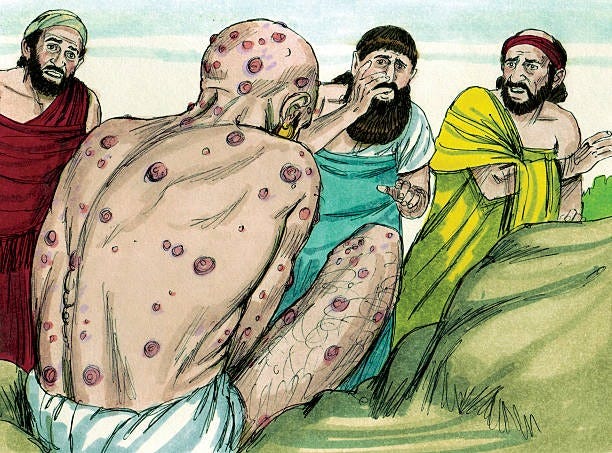
Job clearly is caught up in thinking about his own suffering, as we all do when a Job-like catastrophe hits us. Some might even accuse him of holding a pity party for over 35 chapters. The thinking that results from overt comparisons among people does not often seem to be beneficial, especially for the relationships between Job and his friends, but thinking about how we fall easily into comparisons provokes thoughts worthy of consideration. One might call it a tornado of thoughts to clear a pathway in our thinking about Job, resulting in my next observation about life.
Observation #6 - If we are destined to think by comparison, we must take hold of those thoughts and guide them toward compassion and understanding while resisting categorizing.
2 Corinthians 10:3-5
Indeed, we live as humans but do not wage war according to human standards, for the weapons of our warfare are not merely human, but they have divine power to destroy strongholds. We destroy arguments and every proud obstacle raised up against the knowledge of God, and we take every thought captive to obey Christ.
References
hooks, b. (2015). Feminist theory from margin to center. Routledge.


